

July 10, 2026 · Blogs
In 2025, the Indian children’s dietary supplement market generated revenue of INR 907.2 crore. The market is projected to reach 2,081.5 crore by 2033. These numbers reveal the tremendous growth of the pediatric dietary supplement segment in the nation. It also points towards the ever-increasing need for targeted daily nutrition.
Two of the important nutrients at the center of this demand are Vitamin D3 pediatric drops and essential multivitamins. They are increasingly recommended by pediatricians. Therefore, manufacturing these essential drops has become a top priority for the healthcare industry.
More pharma companies are also launching new multivitamin drops for babies in India. In this guide, we will identify the key drivers as well as find out how WHO-GMP facilities ensure precision manufacturing, and how to choose the right PCD pharma partner for 2026.
Babies grow fast in their first year. Their small bodies need good nutrients every day. Vitamin D helps a baby’s body use calcium. Calcium helps to make strong bones and teeth. Low vitamin D can make bones weak or soft. This problem is called rickets.
Most babies do not get much sunlight. It means babies miss out on natural vitamin D. That is why doctors often suggest vitamin D3 drops for newborn babies. These vitamin D3 oral drops can start in the first few weeks of life.
Here are the main vitamin D3 drops uses for babies:
Vitamin D3 drops for baby uses go beyond bone health — pediatricians also track them for muscle and immune development. Vitamin D3 drops for babies uses stay consistent across brands: a fixed number of drops daily, mixed into milk or water. Vitamin D3 drops dosage for infants depends on the strength prescribed — common options include vitamin D3 drops 800 IU and vitamin D3 drops 400 IU — and should always follow the pediatrician’s advice rather than a standard measure. Parents occasionally ask about vitamin D3 drops side effects; when manufactured under WHO-GMP conditions and dosed correctly, they’re considered safe for daily infant use.
India has one of the largest child populations in the world. Many babies are born every year. Doctors across the country now suggest pediatric multivitamin drops for infants and newborns as part of normal baby care. Parents like liquid drops. They are easy to give. They are gentle on tiny tummies.
The chart below shows an illustrative growth trend for this market from 2025 to 2034.

The Key Growth Drivers of the Pediatric Supplement Market
Here is why this market keeps growing:
1. More awareness.
Parents now know that gaps in nutrition can hurt growth. This awareness leads to seeking trusted pharma brands for child nutrition.
2. Doctor’s advice.
Doctors write drops into checkup plans.
3. City life.
Less time in the sun means more need for drops.
4. Health programs.
The government runs drives to check vitamin D in kids.
5. Online shopping.
Parents can now buy drops with just a few clicks.
Making safe vitamin D3 drops for babies is not easy. Every step must follow strict rules. A good vitamin D3 pediatric drops manufacturer will be meticulous end-to-end.
Manufacturers source pure vitamin D3 from trusted suppliers. Every batch is tested for purity before it’s used. Only pharma-grade material is used in the mix
The vitamin D3 is blended by chemists with a safe oil or water base, commonly formulated as vitamin D3 drops 200 IU, vitamin D3 drops 400 IU, vitamin D3 oral drops 800 IU, or higher-strength vitamin D3 drops 1000 IU, 2000 IU and 4000 IU variants. For multivitamin blends, they may add vitamins A, C, and E too. The taste must stay mild. Babies do not take a drop that tastes bitter or strong.
The drops are made in a clean unit.
Each batch is tested in the laboratory and experts check the vitamin D3 potency. They also test for bacteria and shelf life. Nothing leaves the plant until it passes every test
Bottles use dropper caps. Parents can open them with ease. Clear marks on the dropper help parents give the right amount each time.
The table below compares two common baby drop formats.
| Feature | Dropper Bottle | Oral Syringe Pack |
| Ease of use | Very easy for daily home use | Better for exact hospital dosing |
| Dosing accuracy | Good, with marked dropper | Very high, marked in small units |
| Shelf life after opening | Up to 4–6 weeks | Up to 4–6 weeks |
| Common use case | Home use, daily supplement | Clinical or hospital setting |
| Parent preference | Most popular choice | Used less at home |
Many parents mix up single-nutrient drops and combo formulas. It helps to know the facts about vitamin D3 and multivitamin drops before you pick one.
| Feature | Vitamin D3 Drops Only | Multivitamin Drops |
| Main Goal | Bone and calcium support | All-round daily nutrition |
| Nutrients Inside | Vitamin D3 only | Vitamin D3, A, C, E, zinc, iron and other essential vitamins and minerals |
| Best For | Children with low sun exposure | Children with broader nutritional needs |
| Common Use | Rickets prevention and bone health | General growth and development support |
| Taste | Usually neutral | Often lightly flavoured |
Both drop types stay popular. Many doctors start on plain vitamin D3 drops for babies in the early months. They may add a pediatric multivitamin drops blend later, once the baby starts eating solid food.
Multivitamin & multimineral drops combine core vitamins with minerals like zinc and iron in one daily dose. Multivitamin and multimineral drops, and multivitamin multimineral drops, are increasingly requested by PCD partners — the multivitamin multimineral drops uses span immunity, growth and appetite support. Multivitamin drops uses generally include daily nutrition, immunity building and growth support for babies and toddlers.
Manufacturers offer multivitamin with zinc drops, multivitamin mineral drops, and separate formulations — multivitamin drops with zinc, multivitamin drops with iron, and multivitamin drops with minerals — to match specific nutrition gaps. Children’s multivitamin drops are usually mildly flavoured once babies move to solid food. Franchise partners typically stock multivitamin drops for kids and multivitamin drops for toddlers as separate SKUs, alongside multivitamin drops for infants and newborn multivitamin drops for the youngest age group. Multivitamin and minerals drops remain a strong entry point for a pediatric portfolio, and multivitamin drops dosage always varies by age and brand strength.
Are you looking to run a pharma franchise for children’s healthcare products? Then, picking the right pediatric products from PCD Company is important — see our list of top pediatric pharma companies in India for a starting comparison. It shapes your product quality as well as your market reputation. It also determines your profitability.
Look for these traits in a manufacturing partner:
The image below shows an illustrative share held by each type of pediatric supplement in India.
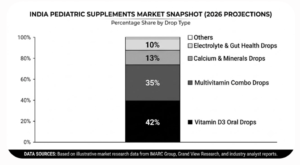
illustrative share held by each type of pediatric supplement in India.
Parents and pharmaceutical enterprises must be seriously committed to quality in early-stage child nutrition. Vitamin D3 pediatric drops and multivitamin blends are both vital pillars for the health and physical development of children.
With demand expected to continue growing through 2026, pharma distributors’ best strategy is to partner with certified, quality-driven manufacturers to bring safe and effective products to market. At Pediavends, we are one of the trusted pediatric healthcare product manufacturers in India. With 200+ product segments and 20+ certifications, we provide partners with quality and complete products and services. To know more about our PCD franchise options and third-party manufacturing, please contact us at +91 9988171626.
Reach out to a certified pediatric products PCD Company. Check their product list and certificates. Then sign a monopoly-based deal for your area.
Look for third-party lab testing, WHO-GMP certification, clear labeling and good supply support.
B2B Pharmaceutical manufacturers assist businesses to lower production costs, increase product quality, accelerate product launches and concentrate on sales and marketing.
Yes, some manufacturers do provide low MOQ to help small businesses with limited budget.
Most startups begin with a small capital of few lakh rupees depending upon the product range and order size.
Dosage of vitamin D3 drops depends on the strength (400 IU, 800 IU or higher) and the pediatrician’s advice — parents should always follow the prescribed dose rather than a fixed rule.
Multivitamin multimineral drops are typically used to fill everyday nutrition gaps — supporting growth, immunity and appetite in infants and toddlers who need broader nutrient support beyond vitamin D3 alone.
When manufactured under WHO-GMP conditions and given at the pediatrician-advised dose, side effects are rare — parents should still watch for any reaction and consult their doctor before starting.

October 14, 2026

October 6, 2026

September 9, 2026

September 1, 2026
Connect with PediaVends for expert guidance on PCD franchise and third party manufacturing.
Contact Us