April 30, 2026 · Blogs
Dry syrup — a powder or granulated formulation reconstituted with water before use — covers a much wider market than pediatric medicine alone. Antibiotics, multivitamins, antihistamines, and cough formulations all rely on the dry syrup format because it holds chemical stability better than a ready liquid, and lasts longer on the shelf. Pediavends manufactures across this range as a WHO-GMP certified dry syrup manufacturer based in Zirakpur, Punjab, offering both third-party manufacturing and private label development.
India’s generic pharma sector produces medicine for over 200 countries, and dry syrups make up a large share of that volume — the format’s stability and low transport risk make it a natural fit for both domestic and export markets. That’s really the whole pitch for why dry syrup manufacturing keeps growing: it solves a real shelf-life problem, not just a pediatric-compliance one.
Dry syrup demand is growing because the format works across nearly every therapeutic category — not just pediatric medicine. Antibiotics, multivitamins, antihistamines, cough formulations, and general oral suspensions all use dry syrup for the same reason: it’s more stable on the shelf than a pre-mixed liquid, and reconstitution at the point of use extends shelf life significantly.
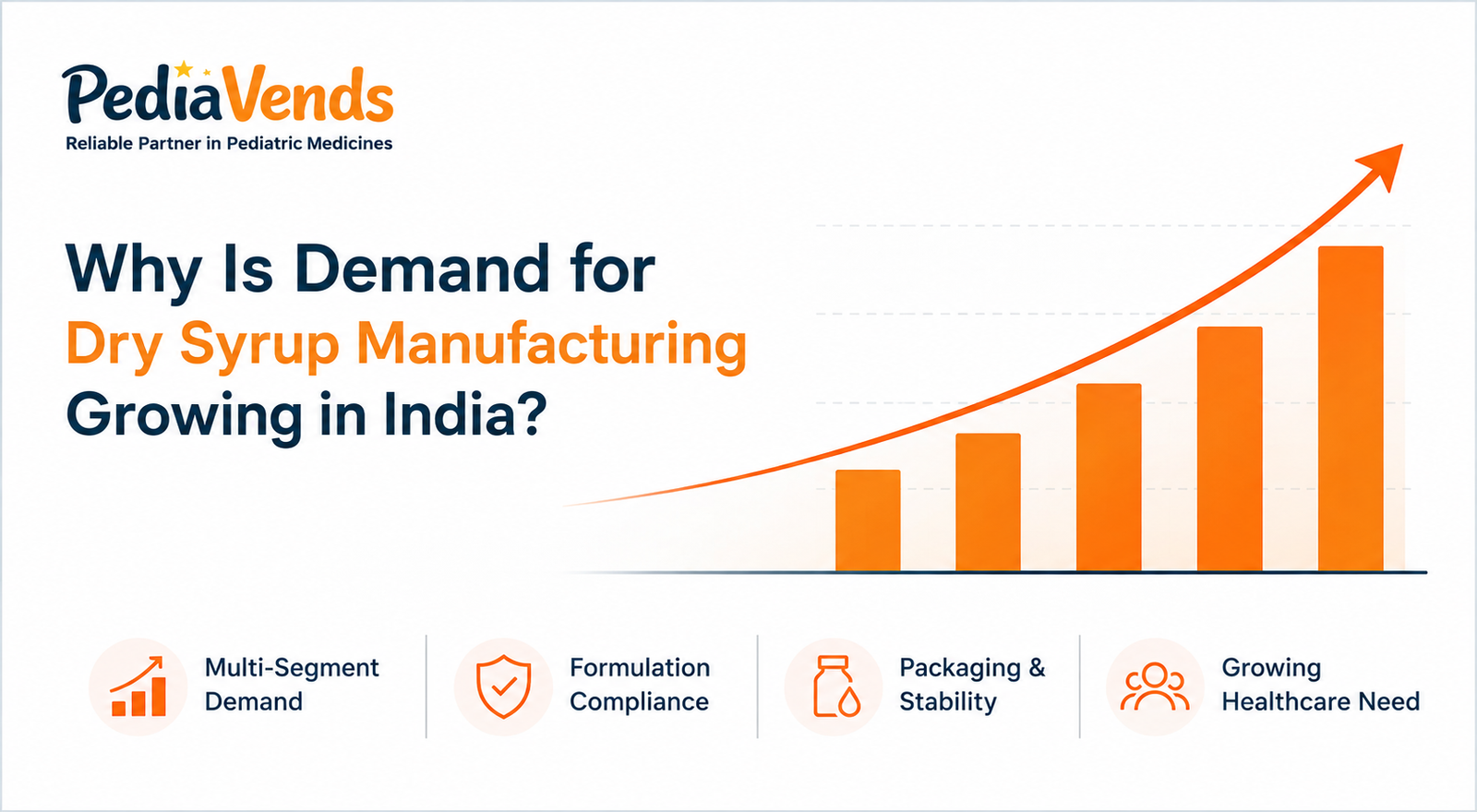
Multi-segment demand. A single dry syrup manufacturing line can support antibiotic suspensions, multivitamin syrups, antihistamine formulations, and pediatric ranges side by side — this is why most WHO-GMP dry syrup manufacturers built in Punjab and Himachal Pradesh don’t limit themselves to one therapeutic category.
Formulation compliance. For pediatric and elderly patients specifically, flavored, sugar-free formulations improve how consistently the medicine actually gets taken — that’s a real driver of demand within the broader category, not the whole story.
Packaging and stability. Moisture-proof HDPE bottles and desiccant sachets are now standard for serious manufacturers, since dry syrup’s main advantage — shelf life — depends entirely on keeping the powder dry until reconstitution.
Partnering with a third-party dry syrup manufacturer means you skip the machinery, raw-material sourcing, and formulation R&D — that cost and complexity stays with the manufacturer, freeing your capital and time for sales and distribution instead.
Before signing with a dry syrup manufacturer, verify their WHO-GMP and ISO certification status, monthly production capacity, molecule range across therapeutic categories, packaging quality, and batch testing reports — these five checks separate a reliable manufacturing partner from a risky one.
Also ask for a detailed cost breakdown up front — per-unit pricing, minimum order quantity, and any packaging or design charges — so there are no surprises once production starts.
Pediavends manufactures dry syrups across antibiotic, multivitamin, cough syrup, and pediatric formulations under WHO-GMP compliant production, with accurate per-bottle dosing and consistent batch quality.
Private label development. Launch your own brand through private label manufacturing — Pediavends handles formulation and production while you own the brand and the market relationship.
Third-party manufacturing. Get finished, ready-to-distribute stock without building your own production line — this is the same third-party manufacturing model covered earlier, applied specifically to dry syrup production.
WHO-GMP compliant batches. Every batch follows WHO-GMP guidelines, from raw material sourcing through final packaging.
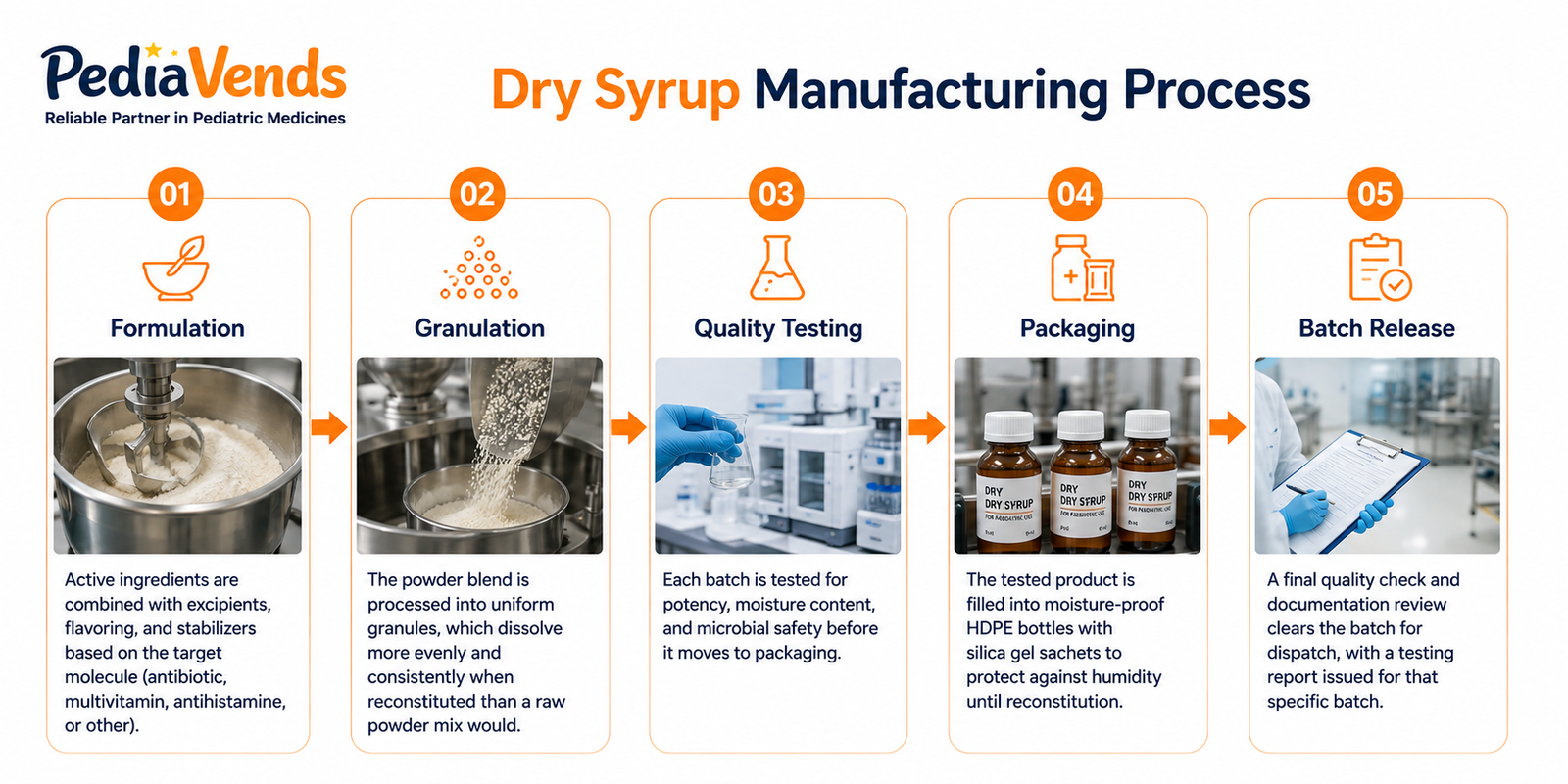
Dry syrup manufacturing process at Pediavends — formulation, granulation, and quality testing
Dry syrup manufacturing follows five documented stages — formulation, granulation, quality testing, packaging, and batch release — each WHO-GMP compliant and traceable back to a specific batch record. This is the same core process used across a general dry syrup manufacturing company’s range, whether the end product is an antibiotic suspension, a multivitamin syrup, or a pediatric formulation.
This five-stage process stays consistent across therapeutic categories — antibiotic, multivitamin, antihistamine, cough syrup, or pediatric — only the formulation stage changes molecule to molecule. That consistency is what separates an established dry syrup manufacturing company from a smaller operation cutting corners on testing or packaging.
Pediavends’ dry syrup manufacturing range spans six therapeutic categories, giving franchise and private label partners a single sourcing point instead of working with multiple manufacturers for different product lines.
| Category | Example Formulations | Common Use |
| Antibiotic | Amoxicillin + Clavulanate, Cefixime, Azithromycin Dry Syrup | Treatment of bacterial infections |
| Multivitamin | Multivitamin & Mineral Syrup Combinations | Nutritional supplementation |
| Cough Syrup | Expectorant & Antitussive Dry Syrups | Relief from cough and cold |
| Anti-Allergic | Antihistamine Dry Syrups | Allergy management |
| Analgesic / Anti-inflammatory | Pain & Fever Relief Dry Syrups | Pain and fever management |
| Pediatric Range | Flavoured, Sugar-Free Dry Syrups Across Multiple Categories | Improved child compliance |
Every formulation in this range is manufactured under the same WHO-GMP dry syrup manufacturing process described above, whether it’s ordered as third-party stock or developed as a private label dry syrup brand.
Dry syrup manufacturing spans far more than one therapeutic category — antibiotics, multivitamins, antihistamines, cough formulations, and pediatric ranges all depend on the same core advantage: shelf stability. Pediavends manufactures across that full range as a WHO-GMP certified dry syrup manufacturer in India, offering both private label and third-party production. If you’re building a PCD pharma franchise or need a reliable dry syrup manufacturing partner, get in touch to discuss your product range.
Ans. Dry syrup offers a longer shelf life and better chemical stability than a pre-mixed liquid, since the powder stays stable until it’s reconstituted with water right before use. This makes it the standard format for antibiotics, multivitamins, and pediatric formulations alike, not just children’s medicine.
Ans. WHO-GMP certification confirms medicines are produced in controlled, sterile conditions with documented quality checks at every stage — it’s the baseline standard to verify before signing with any dry syrup manufacturer.
Yes. Flavoring options like mango, strawberry, and orange are standard for improving compliance, particularly for pediatric and cough syrup formulations.
Ans. Your needs and budget requirements determine the selection of this parameter. The minimum order quantity needs to be between 1,000 and 5,000 bottles based on specific product formulas.
Ans. Production typically takes 30 to 45 days including packaging and labeling. Repeat orders are faster since formulation templates already exist.
Ans. Most third-party manufacturers assist with licensing issues as well as provide you with all required documents.
Ans. Yes, high-quality HDPE bottles and silica sachets provide the best protection against moisture.
Ans. Usually, prices range from twenty-five to eighty rupees, much depending on the molecules and whether the fanciness of them is considered.
Ans. Yes, you can do this with our WHO-GMP-certified medicines.

October 6, 2026

September 9, 2026
September 1, 2026
Connect with PediaVends for expert guidance on PCD franchise and third party manufacturing.
Contact Us