

August 26, 2026 · Blogs
The difference between syrup and suspension comes down to one thing: does the drug dissolve? A syrup is a sugar-based solution — the API dissolves completely, so every spoonful tastes and doses the same. A suspension is a two-phase system — solid drug particles sit in the liquid without dissolving, which is why the label says “shake well before use.” Same dark amber bottle, same job on the shelf. Completely different chemistry underneath, and that one fact decides how each is formulated, manufactured, and dosed.
Syrup is a thick, sugar-based liquid. It is not a mixture. It is a solution in which the drug dissolves completely. Nothing floats. Nothing settles. It stays smooth and even from top to bottom.
• Clear: Good syrup appears clean, no particles.
• Thickness: Sugar (often 66.7% w/w sucrose) gives syrups their body.
• Flavor: Sweetness masks bitter drugs. That’s why syrups are common in children’s and elderly care medicine.
• Shelf life: Water activity is regulated by sugar. This keeps microbes away.
A suspension works the other way. Fine solid drug particles sit inside a liquid. They don’t dissolve into it. It’s a two-phase system. That one fact changes how it’s made.
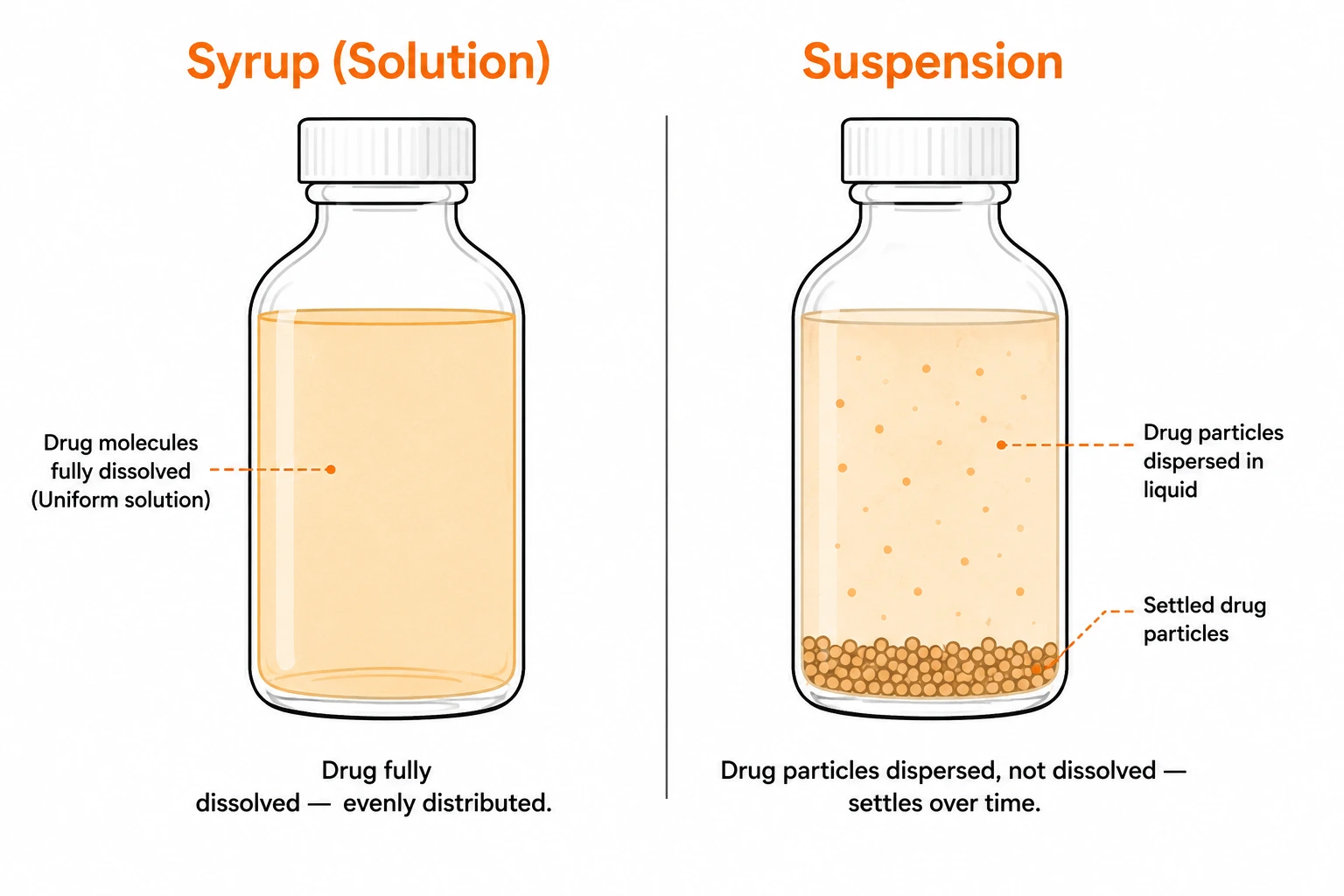
Two phases: Solid particles sit in a liquid, not dissolved in it.
Settling: Particles sink over time. That’s why bottles say “shake well before use.”
Particle size: Makers keep particles between 0.5 and 5 microns to slow this settling.
A syrup vs suspension difference always traces back to solubility — everything else in the table below is downstream of that one variable.
| Feature | Syrup | Suspension |
|---|---|---|
| System Type | One smooth solution | Two-phase mixture |
| API Solubility | Fully dissolved | Insoluble or poorly soluble |
| Appearance | Usually clear | Cloudy; may settle over time |
| Dosing | Uniform; no shaking required | Shake well before use |
| Key Excipients | Sucrose, polyols, flavourings | Suspending, wetting and flocculating agents |
| Main Risk | Sugar crystallisation | Caking or phase separation |
Every row in that table traces back to the same production line — it shapes the quality checks, and it even shapes the bottle label.
Pharmaceutical syrup manufacturing runs through four controlled steps: dissolving sugar in heated purified water, adding the API and excipients once the base cools, filtering out any undissolved particles, and cooling before bottling. It’s fundamentally a dissolving process, get the sugar fully into solution and the rest follows. Any pharmaceutical syrup manufacturer running this pharmaceutical syrup manufacturing process in a pharmaceutical syrup manufacturing plant follows roughly the same pharmaceutical syrup preparation sequence, whether it’s a small setup or a full syrup manufacturing company.
Purified water goes into a jacketed vessel. It is heated to about 60-70°C. Sugar is added under constant stirring. It is stirred until it is totally dissolved.
Once the base cools a little, the active drug goes in. It is also mixed with preservatives like methylparaben, colours and flavours. If the drug needs a bit of help to dissolve, a co-solvent like propylene glycol is also added.
The mix goes through a filter. This removes any undissolved bits. This makes syrups clear and glassy.
Pour the filtered syrup into a storage tank and stir slowly. It cools to room temperature. Then it heads to the bottling line.
Pharma suspension manufacturing runs through four stages built to keep insoluble particles evenly dispersed: hydrating the suspending polymers, wetting and slurrying the API, high-shear milling to set particle size, and de-aerating before filling. It’s a more technical suspension manufacturing process than syrup-making for one reason — the product actively wants to settle, and every stage here exists to fight that.
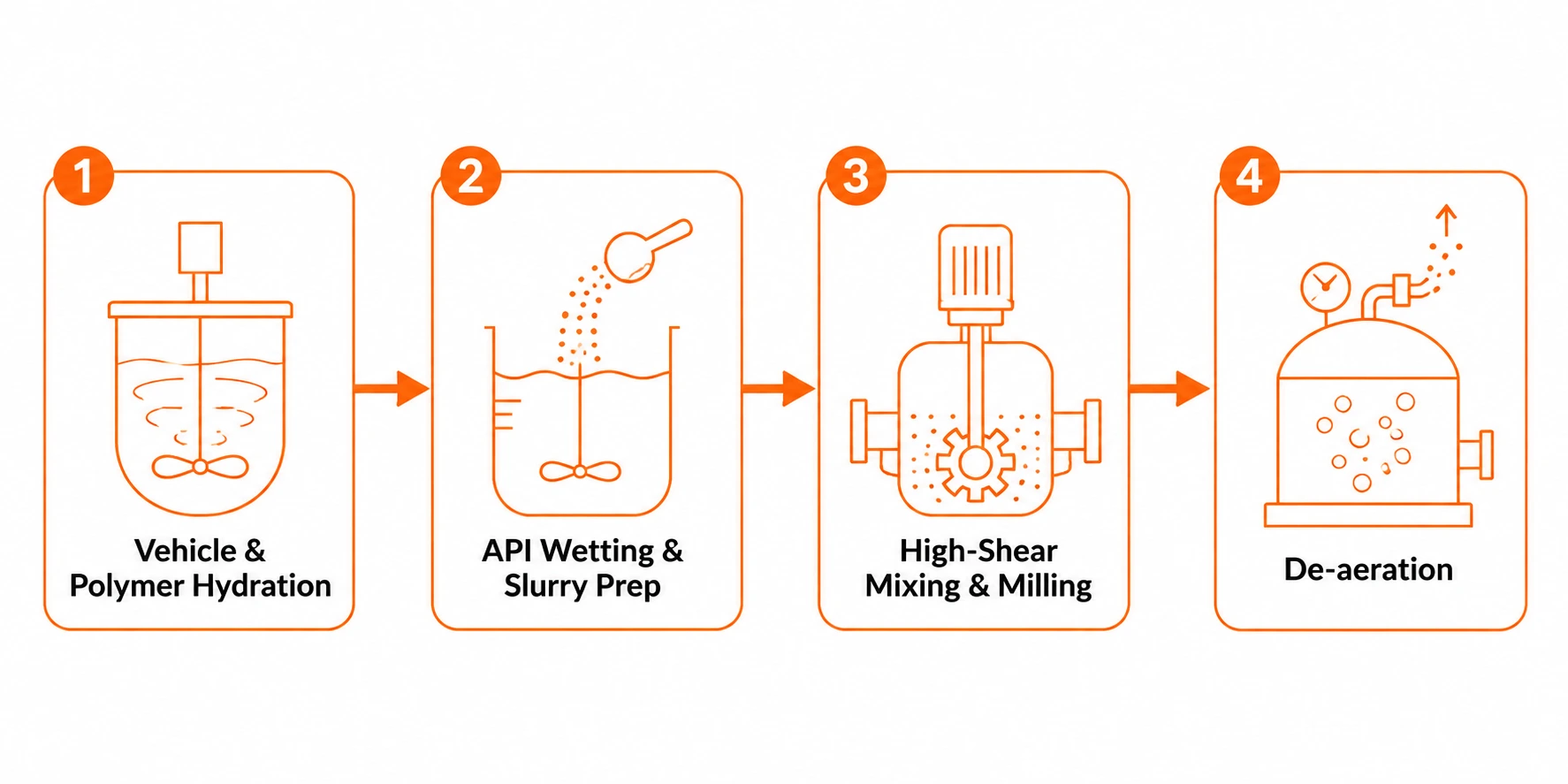
Water mixes with agents like xanthan gum, CMC, or microcrystalline cellulose. These need time to hydrate fully. They build the mix’s thickness.
Many drug powders repel water and float. Wetting agents like Polysorbate 80 break that surface tension first. This lets the drug blend in. It stops clumping.
The wetted slurry goes into the thick vehicle. It then passes through a colloid mill or homogeniser. This step breaks up clumps. It also gets the particle size even.
Fast mixing traps air bubbles in the thick liquid. A vacuum de-aerator pulls that air back out. This keeps bottle fills accurate. It stops early oxidation too. See the suspension manufacturing process flow chart below for how these four stages connect — the same sequence any suspension manufacturing company runs at scale.
See the suspension manufacturing process flow chart below for how these four stages connect — the same sequence any suspension manufacturing company runs at scale.
Three problems account for most formulation failures in a sugar syrup suspension manufacturing plant: sugar crystallisation sealing the cap shut, hard caking at the bottom of a suspension bottle, and getting viscosity right in either format. Each has a specific, known fix.
High sugar concentration is the cause — as syrup cools or partially evaporates near the cap, dissolved sucrose can crystallise out and seal the closure shut. It’s one of the more common manufacturing risks in syrup vs suspension production, and the standard fix is swapping part of the sucrose for sorbitol or glycerin, which resist crystallising the same way.
Hard caking happens when settled particles pack down tight enough that shaking can’t redisperse them. It’s a defining risk in pharma suspension manufacturing precisely because suspensions are built to settle in the first place. Controlled flocculation is the fix — it gets particles to cluster loosely instead of packing hard, so a gentle shake breaks the cluster back up.
Syrups get their body from dissolved sugar; suspensions rely on rheology modifiers instead, since sugar alone won’t keep particles from settling. The better suspension manufacturing process uses modifiers that thicken at rest and thin out when shaken (shear-thinning) — so the product pours easily but still resists settling on the shelf.
That’s the practical version of the difference between syrup and suspension — not the textbook definition, but the version that actually decides a formulation. Get solubility, taste-masking, and stability right at this stage, and cost and shelf life mostly take care of themselves. Get it wrong, and no amount of flavoring fixes a suspension drug vs syrup mismatch after the fact.
Three questions settle most syrup vs. suspension decisions:
Get solubility, taste-masking, and stability right at this stage, and cost and shelf life mostly take care of themselves.
If you need a syrup or suspension manufactured and shipped as a finished brand, Pediavends is a WHO-GMP and ISO-certified pediatric pharma manufacturer already producing both dosage forms at scale — drops, syrups, and suspensions — for 500+ partner brands across India. That combination (both formulation types, one manufacturer, GMP-audited sites) is what most brands are actually searching for when they look up a suspension manufacturing company: fewer vendors, one quality standard, one point of accountability.
What that means in practice for a brand partner:
If you’re evaluating suspension manufacturing companies in India for a syrup or suspension line, get in touch with Pediavends to discuss formulation, capacity, and franchise terms.
The difference between syrup and suspension comes down to one variable — API solubility — and that single fact decides everything downstream: appearance, dosing, shelf life, and how the product has to be manufactured. Syrup is the simpler build when the drug dissolves cleanly and stays stable in solution. Suspension is the right call when the API is poorly soluble, needs particle-level taste-masking, or would degrade too fast once dissolved. In pharma suspension manufacturing and syrup manufacturing alike, the formulation decision isn’t really a preference — it’s dictated by the molecule.
Syrup is one smooth solution where the drug fully dissolves. A suspension is a two-phase mixture, with solid particles of drug suspended in a liquid.
With the time, the suspension particles settle down due to gravity. Before dosing, shaking redistributes them evenly again. Syrups are completely dissolved so the drug is even throughout without any shaking.
High shear mixers, colloid mills, homogenisers, jacketed vessels and vacuum de-aerators. These control the particle size and remove trapped air.
Of course, sugar-free syrups are also created for diabetic patients as well as to prevent tooth decay. They don’t contain sucrose. Instead, they contain sweeteners such as sucralose, sorbitol or liquid maltitol.
It is a technique where the particles are assisted by flocculating agents. It forms a loose cluster instead of a tightly packed layer. The clusters settle down faster but easily redisperse with a gentle shake. This prevents hard caking from forming.
Syrups generally have the longer shelf life. High sugar content controls water activity, which keeps microbial growth down on its own. Suspensions are more prone to physical instability — caking, crystal growth, or particles that won’t redisperse — even when the drug itself is chemically stable, so they often carry tighter storage conditions and shorter re-test periods.
Suspension is usually the safer default, since many formulations use little or no sucrose. But “syrup” doesn’t automatically mean high-sugar — sugar-free syrups built on sucralose, sorbitol, or maltitol exist for exactly this reason (see Q4). Check the label rather than assuming based on dosage form alone.
That depends on what you need — capacity, dosage-form range, and certifications all matter. Pediavends is a WHO-GMP and ISO-certified option focused specifically on pediatric drops, syrups, and suspensions, currently manufacturing for 500+ partner brands with PCD franchise support across North and Central India.

October 6, 2026

September 9, 2026

September 1, 2026

August 10, 2026
Connect with PediaVends for expert guidance on PCD franchise and third party manufacturing.
Contact Us